LT11: The Final Notice of Intent to Levy, and Why Timing Matters
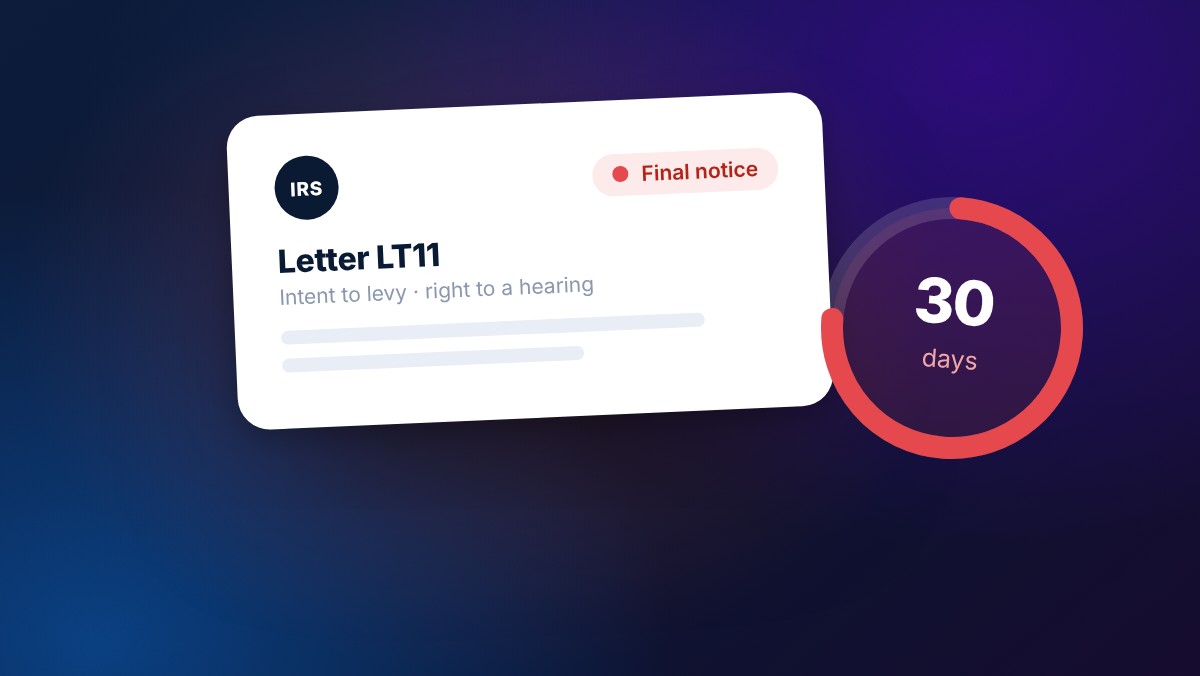
Most IRS letters are requests. The LT11, and its sibling Letter 1058 sent by revenue officers, is different: it is the legal notice the IRS must issue before it can levy, meaning seize, your wages, bank accounts, or other property to collect a tax debt. It is the most serious routine letter in the collection sequence, and it is also the moment you hold the strongest procedural rights you will ever have in the process.
What the LT11 actually is
Federal law requires the IRS to send a Final Notice of Intent to Levy and Notice of Your Right to a Hearing at least 30 days before levying property. The LT11 is that notice. Receiving one means the earlier letters, the CP14 bill, the CP501 and CP503 reminders, the CP504, went unanswered and the account has been queued for enforced collection.
It is worth knowing what a levy can actually reach once the window closes: wages (a continuous levy that takes a portion of every paycheck until released), bank accounts (a one-time sweep of funds on deposit, held 21 days before remittance), Social Security benefits, accounts receivable for the self-employed, and state tax refunds. A federal tax lien, the public claim against your property, may be filed separately and does its own damage to borrowing ability.
The 30-day window and Form 12153
The LT11 starts a 30-day clock, and what you do inside it matters enormously.
Filing Form 12153, Request for a Collection Due Process (CDP) hearing, within those 30 days does three things. It generally halts levy action while the IRS Office of Appeals reviews the case. It gets you in front of an appeals officer with authority to consider collection alternatives, installment agreements, currently-not-collectible status, offers in compromise, and to verify the IRS followed required procedures. And it preserves your right to petition the U.S. Tax Court if you disagree with the determination, which is the only point in the routine collection process where court review is on the table.
Miss the 30 days and you can still request an equivalent hearing within one year. Appeals will hear you, but levy action is not required to stop while it does, and there is no Tax Court review afterward. Same conversation, dramatically weaker position. That asymmetry is the entire reason timing matters.
What actually stops a levy
A hearing request buys review, but the durable ways to stop a levy are the same tools that resolve the balance itself:
- Full payment, which ends the matter.
- An installment agreement. Once an agreement is pending or in place, levy action is generally barred. For individuals owing $50,000 or less who are current on filings, qualification is usually straightforward, up to 72 months, with the failure-to-pay penalty rate cut in half while the agreement is active.
- Currently-not-collectible status, if paying would prevent you from meeting basic living expenses. Collection pauses, though penalties and interest continue.
- An offer in compromise, for the narrower set of cases where the balance genuinely exceeds what the IRS could ever collect. Levy action is suspended while an offer is under review.
What does not stop a levy: ignoring the letter, partial unexplained payments, or waiting to see whether the IRS follows through. On an LT11, it follows through.
If one is in your hands right now
Work the problem in this order. First, establish exactly what is owed and for which years, from the IRS account itself rather than the letter alone, since the letter shows a snapshot and the account shows everything. Second, get current on any unfiled returns, because almost every resolution path requires filing compliance before the IRS will agree to anything. Third, pick your instrument: pay, set up the agreement, or file Form 12153 to protect your rights while you sort out the harder situation. For balances with complications, missing years, business payroll issues, disputes about the underlying tax, this is the stage where experienced representation earns its cost.
The bigger lesson
Every LT11 was once a CP14, and before that it was a balance quietly accruing in an IRS account, visible months before any final notice. The taxpayers who end up staring down a levy deadline are almost never the ones watching the account; they are the ones watching the mailbox. Continuous visibility into the account is what turns a five-alarm letter into a routine item handled early.
Where TaxRock fits
TaxRock’s continuous monitoring surfaces balances, penalties, and advancing collection status while there is still time to act calmly, and Rocky explains what each change means. Decode your notice free, or see where your account stands.
Sources
- IRS, Understanding your LT11 notice or Letter 1058
- IRS, Collection due process (CDP) FAQs
- IRS, Form 12153, Request for a Collection Due Process or Equivalent Hearing
- Taxpayer Advocate Service, Form 12153 guidance